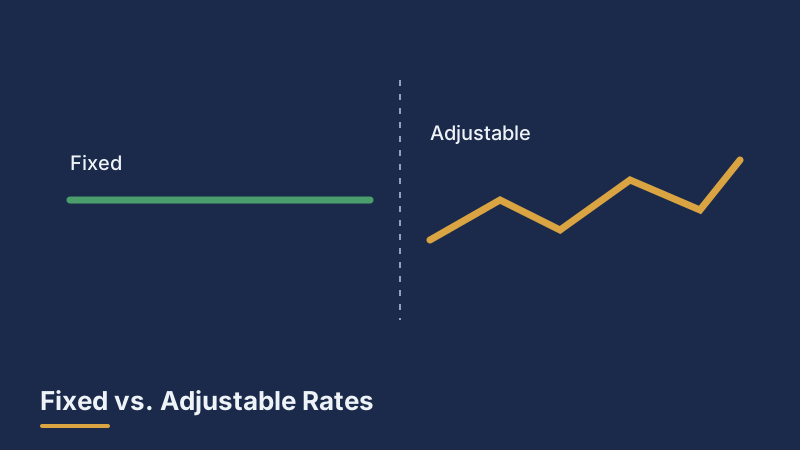
One of the first decisions a mortgage borrower faces is choosing between a fixed-rate and an adjustable-rate mortgage (ARM). Neither is universally better; each suits different plans and risk tolerances.
How a Fixed-Rate Mortgage Works
With a fixed-rate loan, your interest rate is locked for the entire term, commonly 15 or 30 years. Your principal-and-interest payment never changes, regardless of what happens in the broader economy. Property taxes and insurance can still move, but the core loan payment is predictable.
That predictability is the main appeal. Budgeting is simpler, and you are insulated from rising rates. The trade-off is that fixed rates are often set somewhat higher than the initial rate on a comparable ARM, and if market rates fall significantly, you would need to refinance to benefit.
How an Adjustable-Rate Mortgage Works
An ARM typically starts with a fixed introductory period, often five, seven, or ten years, after which the rate adjusts periodically based on a market index plus a set margin. A loan described as a 7/6 ARM, for example, is fixed for seven years and then adjusts every six months.
Important protections to understand before signing:
- Initial cap: limits how much the rate can change at the first adjustment.
- Periodic cap: limits each subsequent adjustment.
- Lifetime cap: sets a ceiling on how high the rate can ever go.
Ask your lender to walk you through the worst-case payment under the caps. If that payment would strain your budget, an ARM may carry more risk than it is worth for you.
Matching the Loan to Your Plans
A fixed-rate mortgage often suits people who expect to stay in the home long term, value payment certainty, or are stretching their budget and cannot absorb an increase.
An ARM can make sense for borrowers who realistically expect to sell or refinance before the fixed period ends, or who have the financial cushion to handle potential adjustments. The lower introductory rate can reduce costs during the years they actually hold the loan.
Questions to Ask Before Deciding
- How long do I genuinely expect to keep this home and this loan?
- Could I still afford the payment if my ARM adjusted to its lifetime cap?
- How do the total costs compare over the period I expect to hold the loan?
- Does my income stability favor certainty or flexibility?
There is no universally correct answer, and no one can guarantee where rates will be when an ARM adjusts. The right structure is the one that fits your timeline, budget, and tolerance for uncertainty. Reviewing both options side by side with clear numbers is the most reliable way to decide.
Article Was Generated By AI.