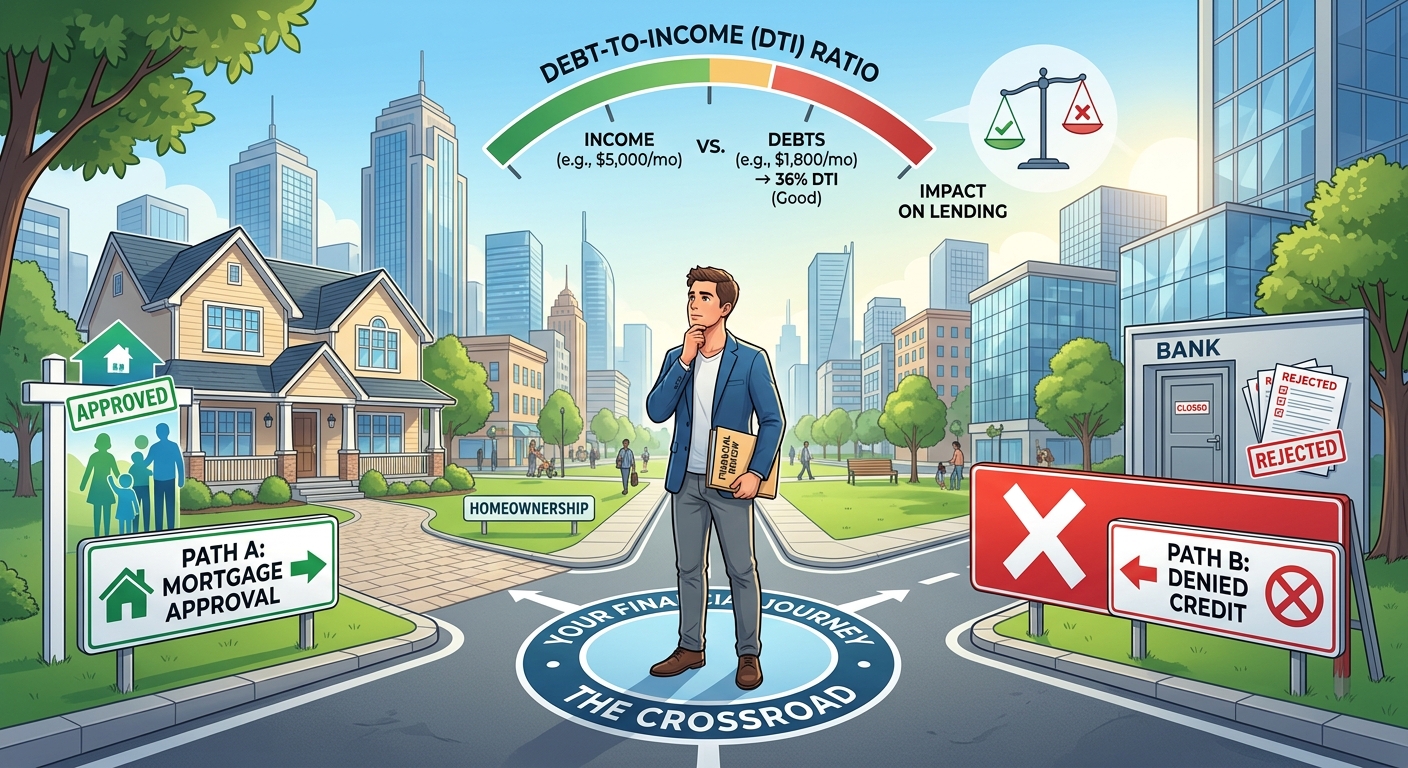
When prospective buyers begin preparing for homeownership, credit scores usually dominate the conversation. However, underwriters evaluate a second, equally decisive financial metric during the qualification process: the Debt-to-Income Ratio Mortgage applicants carry relative to their income. Understanding how this calculation works is essential for satisfying standard Mortgage Approval Requirements and securing favorable borrowing terms.
While most home buyers know that a strong credit score demonstrates credit reliability, fewer understand how lenders measure their ongoing ability to manage new monthly debt obligations. A high credit score proves you pay your bills on time, but your debt ratio determines whether you can realistically afford an additional monthly mortgage payment alongside existing liabilities.
Understanding this qualifying ratio puts you in direct control of the financing process. In this guide, we will define debt ratios, explore front-end and back-end limits, demonstrate how underwriters calculate your numbers, and show you how to utilize a DTI Calculator Home Loan strategy to optimize your borrowing capacity. Working alongside vetted mortgage specialists allows you to interpret these figures accurately and enter the home loan application process with complete confidence.
What Is Debt-to-Income Ratio?
Your Debt-to-Income (DTI) ratio is a personal finance metric that measures the percentage of your gross monthly income (before taxes and deductions) required to cover your recurring monthly debt obligations, including your prospective new housing payment.
Mortgage underwriters break this calculation into two separate ratios:
Front-End Ratio (Housing Ratio)
The front-end DTI isolates your proposed housing costs alone. This includes principal, interest, property taxes, hazard insurance, and homeowers association (HOA) fees relative to your gross monthly income.
Back-End Ratio (Total Debt Ratio)
The back-end DTI combines your prospective total housing payment with all other recurring monthly debts, such as auto loans, student loans, credit card minimum payments, and personal lines of credit. Underwriters place heavy emphasis on this total debt ratio when reviewing applications.
Calculating your baseline debt ratio involves dividing your total monthly recurring liabilities by your gross monthly earnings, then multiplying by 100 to yield a percentage:
For example, if an applicant carries $2,000 in monthly recurring debt obligations (including student loans, auto financing, and the proposed mortgage payment) and earns a gross income of $6,000 per month, the calculation yields:
Why DTI Matters as Much as Your Credit Score
It is helpful to view credit scores and debt ratios as two halves of a complete financial profile. Your credit score reflects past payment behavior, while your DTI ratio measures active capacity. Even buyers with flawless credit histories can face loan denials or reduced purchasing power if their monthly income is already stretched thin by existing financial commitments.
Mortgage programs establish specific risk ceilings for back-end debt ratios during underwriting:
- Conventional Loans: Typically target a back-end DTI cap of 36% to 43%, though automated underwriting systems may approve ratios up to 45% or 50% for applicants with strong compensating factors (such as high liquid cash reserves).
- FHA Loans: Offer flexible guidelines, permitting standard ratios up to 43%, with potential approvals extending to 50% or higher for strong credit applicants.
- VA and USDA Loans: VA guidelines set a baseline benchmark of 41%, but allow flexibility for qualifying service members with strong residual income calculations.
Navigating these limits is easier when you evaluate both your credit and debt profile in tandem, giving you a clear picture of overall Mortgage Approval Requirements before you begin house hunting.
How DTI Impacts Your Borrowing Limit
Your debt ratio dictates more than just approval or denial; it directly sets your maximum purchasing limit. Underwriters reverse-engineer your maximum allowable loan size by applying program-specific DTI caps to your documented gross monthly income.
A lower DTI ratio grants underwriters room to approve higher loan amounts, unlocking access to competitive pricing tiers. Conversely, carrying elevated monthly debts restricts maximum loan size, regardless of how high your home purchase budget might be.
Running your numbers through a DTI Calculator Home Loan tool prior to shopping lets you estimate your qualifying boundary in advance. Testing different home price points, property tax assumptions, and down payment sizes helps prevent surprises during pre-approval and underwriter review.
Common Debts That Count Toward DTI
Understanding which financial obligations underwriters include—and exclude—allows you to structure your finances effectively before submitting an application.
Obligations Lenders Include in DTI Calculations
- Minimum monthly credit card payments
- Auto loan installments
- Student loan monthly payments (including income-driven repayment amounts)
- Personal loans and lines of credit
- Court-ordered child support or alimony obligations
- Proposed housing costs (Principal, Interest, Taxes, Insurance, and HOA fees)
- Monthly payments on secondary real estate or co-signed debts
Expenses Excluded from DTI Calculations
- Utility bills (electricity, water, internet)
- Groceries, medical care, and personal living expenses
- Auto, health, and life insurance premiums (unless escrowed within the mortgage)
- Cellular phone service plans
- Voluntary 401(k) or retirement plan contributions
Important Note on Co-Signed Obligations
If you co-signed a car loan or personal loan for a family member, underwriters must count that monthly payment in your DTI ratio—unless you can provide 12 consecutive months of canceled checks proving the primary borrower made all payments directly from their own account.
How to Lower Your DTI Before Applying
If your initial calculations reveal a debt ratio that exceeds standard qualifying limits, proactive debt management can quickly improve your numbers:
- Pay Down Revolving Debts Strategically: Target small credit card balances or installment loans with few remaining payments. Eliminating a $150 monthly credit card minimum or a $250 auto payment directly reduces your debt numerator, raising your maximum borrowing power.
- Document Additional Income Streams: Adding verifiable income lowers your ratio proportionally. Overtime earnings, annual bonuses, part-time jobs, or freelance work can be counted if you show a consistent 2-year history on tax documentation.
- Avoid New Credit Financed Purchases: Refrain from opening new credit cards, financing furniture, or buying automobiles in the months leading up to a mortgage application. Adding new monthly liabilities immediately compresses your qualifying borrowing margin.
- Explore Flexible Loan Programs or Term Extensions: Adjusting your mortgage term or choosing loan programs with higher debt allowances can help align your profile with standard qualification guidelines.
Consulting an experienced loan officer provides personalized insight, allowing you to build an action plan tailored to your timeline and financial targets.
Take Control of Your Mortgage Qualification
Along with reviewing what mortgage lenders actually see on your credit score, mastering your Debt-to-Income ratio gives you a distinct advantage as a home buyer. Rather than leaving approval to chance, tracking your debt commitments and income metrics puts you in a position of strength when applying for home financing.
Using a DTI Calculator Home Loan evaluation tool provides an accurate snapshot of where you stand today. Connecting with an experienced mortgage specialist gives you a tailored assessment of your qualifying options, ensuring you secure the right financing terms for your long-term goals.
Frequently Asked Questions
Most conventional mortgage programs prefer a back-end Debt-to-Income ratio of 36% to 43%. However, applicants with strong credit scores, substantial down payments, or liquid cash reserves can often secure automated underwriting approvals up to 45% or 50%.
Yes. Underwriters include student loan monthly obligations in your back-end DTI. If your student loans are in deferment or on an Income-Driven Repayment (IDR) plan with a $0 payment, guidelines require lenders to use the documented IDR payment or calculate a small percentage (typically 0.5% to 1%) of the total loan balance as the monthly debt amount.
Yes, depending on the loan program. Government-backed loans like FHA mortgages often permit DTI ratios up to 50% (and occasionally higher) when supported by automated underwriting approvals and strong compensating factors, such as solid credit performance or post-closing reserves.