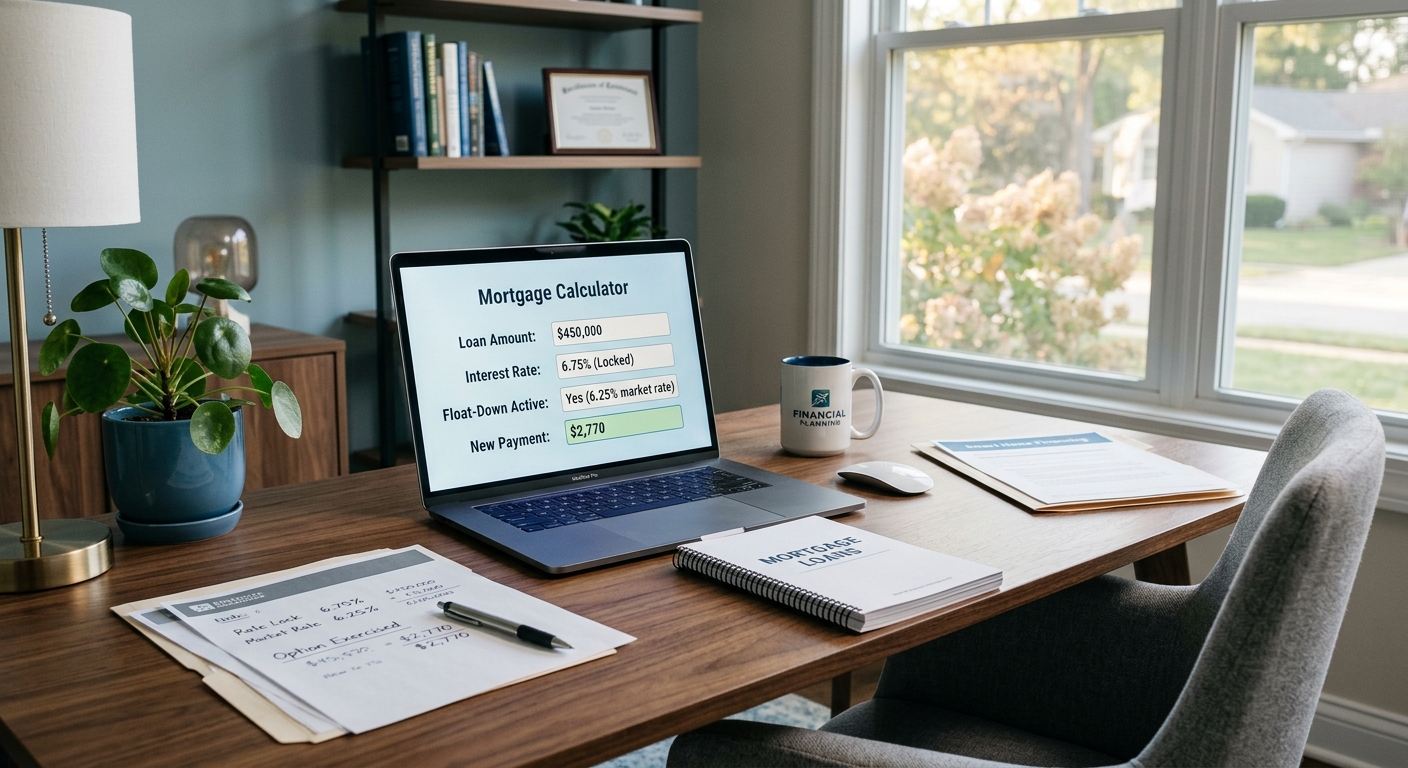
Navigating interest rate volatility during the home loan process can be an overwhelming experience for home buyers. Watching daily fluctuations in borrowing costs often creates uncertainty at a time when financial confidence matters most. A sudden spike in interest rates can unexpectedly stretch your monthly budget or reduce your total purchasing power. To manage this uncertainty, many borrowers turn to a rate lock float-down option—a strategic financing tool that provides a capped maximum interest rate while allowing you to capitalize on market drops before closing.
Securing a rate lock float-down allows you to establish a firm ceiling on your mortgage rate while keeping the door open to lower borrowing costs if market conditions improve. In this guide, we will break down how float-down features operate, compare them to standard rate locks, outline associated fees, and provide a clear framework to help you decide whether locking, floating, or using a float-down option aligns best with your home financing strategy.
What Is a Rate Lock Float-Down Option?
A rate lock float-down option is a specialized mortgage agreement that combines the security of a standard rate lock with the flexibility of a market float. When you lock your mortgage rate initially, your lender guarantees that your interest rate and points will not increase prior to closing, protecting you against rising market rates.
However, under a conventional rate lock, if market rates drop during your underwriting period, your locked rate remains unchanged. A float-down provision resolves this limitation by granting you a one-time option to reset your locked rate to a lower prevailing market rate if interest rates experience a meaningful drop before your loan documents are finalized.
| Option Type | Protection Against Rate Increases | Benefit from Rate Decreases | Primary Use Case |
|---|---|---|---|
| Standard Rate Lock | Yes (Capped) | No | Best when rates are steadily rising or volatile. |
| Floating Rate | No (Exposed) | Yes | Best when rates are trending downward rapidly. |
| Rate Lock Float-Down | Yes (Capped) | Yes (One-time adjustment) | Best for maximum flexibility during uncertain markets. |
How Does a Rate Lock Float-Down Work?
While specific terms vary across mortgage lenders, the basic mechanics of executing a rate lock float-down generally follow a standardized sequence:
- Initial Rate Lock: Upon pre-approval or contract acceptance, you lock in a baseline interest rate for a set period (typically 30, 45, or 60 days).
- Market Monitoring: Throughout the processing and underwriting period, you and your loan officer monitor prevailing interest rate movements.
- Meeting the Threshold Trigger: Most float-down agreements stipulate that market rates must drop by a minimum threshold—commonly 0.25% (25 basis points) or more—before the float-down can be executed.
- Exercising the Float-Down: If market rates drop past the required threshold within your eligible window, you submit a formal request to your lender to adjust your rate down to the lower current market level.
- Closing at the Lower Rate: Your loan documents are updated to reflect the reduced interest rate, permanently lowering your monthly mortgage payment for the life of the loan.
Because eligibility windows and execution windows are strictly governed by lender contracts, borrowers should always request written confirmation detailing the exact parameters of their float-down feature prior to locking.
Why Interest Rate Volatility Makes This Option Valuable
Mortgage interest rates fluctuate daily based on broader macroeconomic indicators, inflation reports, bond market yields, and central bank policy decisions. During periods of heightened economic uncertainty, rate shifts can be significant even over short 30-day windows.
Even a minor adjustment in your interest rate can substantially impact your long-term borrowing costs. For example, on a $400,000 fixed-rate home loan, a 0.25% reduction in interest rate reduces your principal and interest payment by roughly $60 to $70 per month. Over a 30-year repayment schedule, that single reduction equates to more than $20,000 in total interest savings.
Utilizing a float-down option provides peace of mind for rate-sensitive buyers. It eliminates the anxiety of "locking too early" and missing out on potential market dips, while simultaneously preventing the risk of "waiting too long" and getting caught in a sudden rate spike.
Rate Lock Float-Down vs. Fees: What to Expect
Lenders assume financial risk when offering float-down privileges, as they must absorb administrative costs and market recalibrations when reducing a previously committed rate. Consequently, float-down features typically carry associated costs or conditions that borrowers must evaluate.
Common Fee Structures
- Upfront Float-Down Fee: Some lenders charge a non-refundable upfront fee (often ranging from 0.25% to 0.50% of the total loan amount) at the time of locking to add the float-down option to your agreement.
- Slightly Higher Base Rate: Other lenders may offer a float-down feature without an upfront fee, but will set your baseline locked rate slightly higher (e.g., 0.125% higher) than their standard rate lock.
- Margin Retainment: In some agreements, if market rates drop by 0.50%, the lender may pass along a 0.375% reduction to the borrower while retaining 0.125% to cover re-underwriting costs.
Evaluating the Financial Math
To determine if paying for a float-down feature makes sense, calculate your break-even point. For instance, if a lender charges a $1,000 fee to add a float-down feature on a $350,000 mortgage, and a successful float-down saves you $65 per month, you break even on the fee in roughly 15 months. If rates remain flat and you never exercise the option, the fee represents the cost of your interest rate insurance policy.
Should You Lock or Float Your Mortgage Rate?
Choosing between a standard rate lock, floating your rate completely, or securing a rate lock float-down depends on your personal risk tolerance, market trajectory, and closing timeline. Consider the following criteria when making your decision:
- Timeline to Closing: If your closing date is less than 15 days away, market fluctuations have limited time to create meaningful savings. A standard rate lock is typically sufficient. If your closing is 45 to 90 days out (such as for new construction), a float-down feature offers long-term protection.
- Budget Sensitivity: If your debt-to-income (DTI) ratio is close to maximum underwriting thresholds, any rate increase could jeopardize your loan approval. Securing a rate lock with a float-down option guarantees your maximum payment stays within qualifying guidelines.
- Prevailing Market Trends: When market forecasts point toward declining rates, floating or securing a float-down provides downside capture. In an inflationary environment with rising rate forecasts, locking early remains the safest approach.
Protecting Your Financing Strategy
A rate lock float-down provides a balanced, flexible approach to home financing in unpredictable markets. By pairing the ceiling security of a traditional rate lock with the downside capture of market drops, home buyers can protect their purchasing power and lock in long-term affordability with confidence.
Work closely with your loan officer to evaluate your timeline, review written float-down terms, and analyze current market trends before selecting your rate lock strategy.